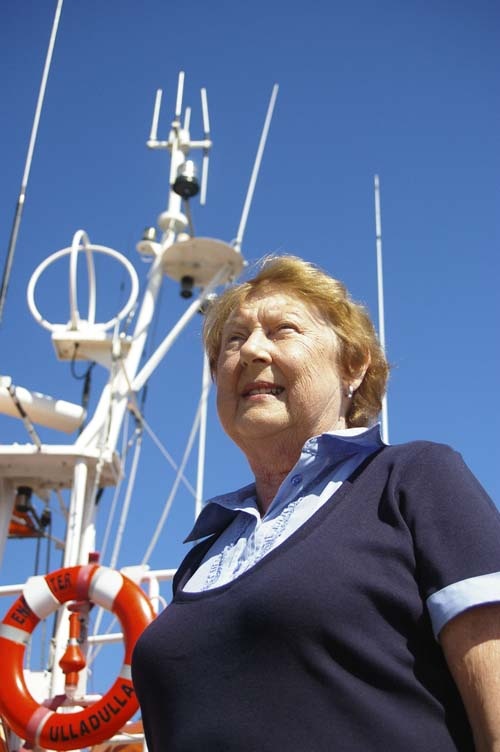
IT’S been 50 years since a young Marion Adamson stepped aboard a ship and into a world that would revolutionise music in the UK.
The Mollymook retiree is a pioneer of Radio Caroline, England’s illegal offshore radio station made famous with the release of the movie The Boat That Rocked.
And rock it did!
“Those were wild, fun times,” Mrs Adamson said.
“We were free, we were rebellious, it was the ’60s and anything was possible.”
A radio music programmer in Sydney, Marion travelled to London at the age of 25 and through her connections ended up on board the Mi Amigo the very first Radio Caroline ship that operated in international waters off the coast of Essex.
The group of young rebel rockers began broadcasting on Easter Sunday, 1964 with the Rolling Stones’ single ‘Not Fade Away’.
The station, with its mix of modern music from the likes of the Stones, Beatles and Dusty Springfield and a series of hip programs, became an overnight success with seven million listeners tuning in across the UK in the first week.
“We had no idea there would be such a phenomenal response,” Mrs Adamson said.
“But with no commercial radio permitted in England at the time we broke new ground and had 22 million listeners after the first month.”
Commercial radio was illegal in the BBC-dominated UK, so the off-shore radio operators were soon dubbed the radio pirates and developed a cult following that still exists today.
“It was totally illegal and the government did all it could to sabotage us, but we got around that by getting our supplies sent via Spain and being paid through Panama.
“It was illegal to supply the ship with food or records or to advertise or provide financial backing to the station and we paid no taxes or royalties to the British Government,” she said.
“Because it was also illegal to board the ship, we would catch a supply boat out into international waters and jump across in the middle of the North Sea.”
“It could be pretty hairy at times, especially during a force eight gale, but it was a real adventure,” she said.
The first woman on board, Marion worked on Radio Caroline for two years, travelling back to her base in London every two weeks.
She said the pirates received a fabulous response from the public and opened the floodgates for commercial radio and rock music in the UK.
“At the time the BBC was the only radio station and it was very staid and conventional.
“We were out there, fun and the whole thing rocked – that’s what the people wanted in the ’60s.
“We changed the future of music in Britain and the world.”
Marion said the Mi Amigo sunk during heavy seas in 1980, but Radio Caroline still operates today – with a licence and on land.
Many of the original Caroliners still keep in contact and share memories of good times on board in the 1960s when dreams came true.
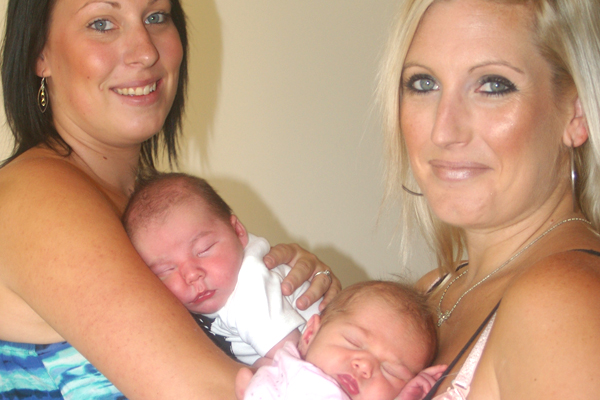
THEY had been joking about it all through their pregnancies, but Shoalhaven sisters Danielle Harris and Chloe McLeod didn’t expect their babies would actually be born on the same day.
At 9am on February 10, Danielle gave birth to baby Anaya Madison Star and, six hours later, Chloe delivered baby Ryder Luke in the same bed, in the same ward at Milton-Ulladulla Hospital.
The siblings helped each other through their labours, with family members sharing in the double delight.
First to go into labour, Danielle arrived at the hospital at 2am with partner Andrew Neilsen and her sisters Chloe and Melissa, who is also pregnant.
Following the birth of eight pound five ounce Anaya seven hours later, she was moved out of the birthing ward.
Within four hours, Chloe went into labour already exhausted after being up all night with her sister, and two hours later baby Ryder was born weighing nine pound five ounces.
Danielle and baby Anaya joined Chloe’s husband Steve and their sister Melissa for the second birth.
“We joked through our whole pregnancies that we’d deliver on the same day, but we didn’t think it would really happen,” Chloe said.
“I’m still in shock.”
Danielle said the sisters were “famous” in the hospital following the eventful day.
“It was pretty crazy in there,” she said.
Both girls learned they were pregnant on the same day in June last year and have shared every step of their pregnancies.
Danielle now has four children, while Chloe is the mother of two.
“We always go in with each other during labour and have watched all of each other’s babies being born,” Danielle said.
Chloe said the sisters were close and shared a special bond.
“She always seems to know what I’m going to do before I do it,” she said.
The siblings grew up in Melbourne and both have lived in the Ulladulla district for about seven years, although Danielle recently moved to Old Erowal Bay.
The girls’ doctor Brett Thomson said the sibling double delivery was a first for Milton Hospital – at least in recent years.
“I can’t recall it ever happening before,” he said.
“For us it was a bit of fun because all through the pregnancy we predicted they would go on the same day and talked about getting a double bed in the ward.
“When they did come in on same day, it was a bit of a hoot for everyone.”
Big John, named after its first owner and Joe Meli’s father, still bobs proudly in Ulladulla Harbour where it has been moored for more than 50 years.
The 18-foot clinker is used by Joe and his older brother Fred two or three times a week and almost daily when their grandchildren come to visit.
“I head out fishing whenever I can,” Joe said.
“I think my dad would be looking down and very proud to see that we are still using his boat.”
The boat was built by shipwright Jack Kemp at Tomerong in 1964 and towed by a Vanguard ute to Ulladulla Harbour where has spent the past five decades.
Joe said the vessel was designed by his father based on the fishing boats used in his home country of Malta.
“Dad was an old sea dog back home,” he said.
“He was a police officer and in the water police, so he loved boats.”
John moved to Australia in 1949 and his wife and nine children soon joined him at their new home in Queanbeyan.
Joe was a teenager at the time and recalls coming on holidays to Ulladulla where his family rented a hut on the harbour foreshore.
“We have been coming here for about 58 years,” he said.
“When dad got his boat, we used to spend a lot of time fishing together.
“Ulladulla has always been a special place for us.”
Joe and his wife Mary still live in Canberra, but have a holiday house in Ulladulla and the semi-retired plumber spends as much time here as he can.
His brother Fred lives in Ulladulla and also enjoys fishing in his own boat.
Joe said Big John had been the longest permanently moored boat in the harbour and he hoped it would remain there for many years to come.
“My grandson is the fourth generation to use the boat,” he said.
“He loves going out when he visits from Canberra and it’s great that he is getting out and learning about the sea and the weather and catching fresh fish – it’s a family tradition.”
Both Joe and Fred spend a lot of time maintaining the vessel and its diesel motor to keep it in tip-top condition after their father died in 1978.
Big John has broken its mooring a few times and, about 30 years ago, the pair drove from Canberra to Ulladulla to salvage it off the rocks north of the harbour following a storm.
“My dad was very proud of his boat and we are very proud to be able to keep using it.
“It made him very happy and now my grandkids are happy too.”
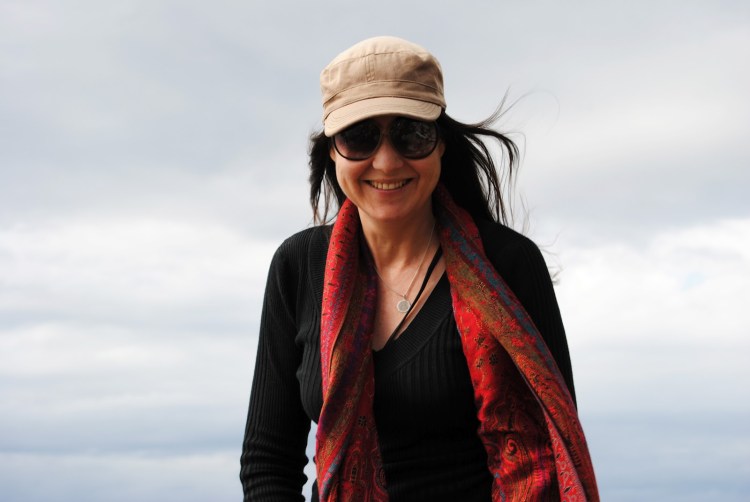
Australian woman Emily Richardson married an Egyptian Muslim man 17 years ago and the couple are now raising their two sons to be “respectful and accepting of other people’s beliefs”, splitting their lives between the bustling metropolis of Cairo and a pristine beach hamlet on the South Coast of NSW.
“Our similarities are much greater than our differences… if more people could get into that mental space, the world would be much better for it.”
Emily Richardson didn’t know how her parents would react when she rang to tell them she was getting married. It wasn’t the fact that she was on the other side of the world, or that she was marrying an Egyptian man – it was that he was Muslim.
Emily grew up on a farm in New South Wales, Australia, where she, her three brothers and their parents attended the local Presbyterian service every Sunday and said grace before dinner each night. With a strong Scottish heritage, Emily’s upbringing was far from multicultural, attending an Anglican high school and an all-girls Christian school in Sydney. In fact, she had no idea about the Middle East and no exposure to Islam.
“I had absolutely no understanding of the culture and it wasn’t really on my radar. There was no frame of reference for me.”
The stereotypical perception of the Islamic religion – bearded men and oppressed women – fuelled Emily’s trepidation in telling her parents. But, as it turned out, the family was supportive of her decision and they were interested in learning more about Muslim beliefs and customs.
“I thought mum and dad might freak out – maybe they did and just didn’t say anything,” Emily said. “I’m sure they had many reservations about the situation, stemming from the fact that they knew little about the culture and hadn’t met Ahmed, but I didn’t doubt that they’d be supportive of us and welcome him into the family, which they did.”
Some of Emily’s friends weren’t so supportive, warning her she was making a huge mistake. “I did have a couple of friends who were very concerned that I was getting into a situation that would backfire badly for me,” she said. “One friend was horrified and tried to talk me out of it.”
They had met two years earlier when Ahmed spotted Emily through the crowd at a rooftop party in Cairo, where she had just taken up a position teaching English in 1999. “As legend has it, he saw me from across the other side of the roof and decided we had to meet,” she laughed. “He was very open and friendly – and very funny. We were great friends and had a very easy relationship from day one.”
A few weeks after meeting, Ahmed took Emily to meet his family. They warmly welcomed the Australian woman who was still finding her feet in a foreign land. “His family was very accepting of me,” she said. “They knew I’d been raised in a Christian environment and, as Christians and Muslims believe in the one God, it wasn’t a problem. “I’m sure his family had some concerns about the cultural differences at first, but they realized pretty quickly that Ahmed was serious about me and they got on with getting to know me. “They are all very open-minded and easygoing. Now I feel just like one of the family.”
It was a similar story when Ahmed came to Australia and met Emily’s parents and brothers. The couple spoke early on about children and how they would be raised. “It’s very, very important to have all the big discussions prior to marriage,” she said. “What religion the children will be and what the expectations of both partners are.”
Now living with two sons, Ziad and Nazar, in Australia, with her parents and one brother just around the corner, Emily and Ahmed are lapping up the Aussie laidback lifestyle. “Ahmed loves it here,” Emily said. “We spend a lot of time at the beach and going for long walks. Ahmed is a great dad and does a lot with the boys.”
But every day she’s in Australia, walking on a deserted pristine beach, surrounded by bushland – a life that many would give their right arm for – Emily is dreaming of being back in Cairo. Egypt has dug its claws in deep. The family spends about three or four months a year in Heliopolis, a middle class suburb of Cairo. “When I’m there, I feel like I’m in the centre of the universe and, when I’m away, I can’t wait to go back,” she said. “I like it here, in Australia, but it just doesn’t touch me like Egypt does – the smells, the activity – all your senses are bombarded. It’s so vibrant, pulsating and exhausting and life is lived in the moment. I love the whole Egyptian culture, the music, language, the food. You walk outside and there are kids playing soccer in the street, men selling bread, men selling fairy floss, women selling vegetables on the corner. Even if you’re completely alone, you feel a part of the community around you.”
She said the boys thrive on being exposed to the culture and the language. “Nazar loves all the stray cats in Egypt and Ziad loves going to the markets. They see extreme poverty and interact with kids who are dirt poor and kids who are very well off. They see that money doesn’t make a good person through their interaction with these children and the dynamics in their little group of friends and acquaintances – life for the majority of people in Egypt is a struggle.”
Emily said many Westerners still held a distorted view of the Middle East, its people and its culture. She said the people there had an “almost magnetic quality” about them. “Egyptians possess a certain indefinable quality that is really difficult to describe – even in their darkest moments, of which there have been many in the last ten years. And the Egyptian sense of humour is unbeatable – Egyptians are hilarious.”
Despite the common belief that Muslim men who marry foreign women demand their wives convert to Islam, Emily explained that, “It’s expected that the children will be Muslim but other than that no real conversion of beliefs is expected – although it differs depending on the socioeconomic status of the family, and most families would greatly hope that the woman would adopt their beliefs for her own sake.” She said at no time was she asked to convert to Islam and she was not required to wear a headscarf while in Egypt – expect when entering a mosque. “There is a definite stereotype about not only women who convert to Islam, but all Muslim women being dominated and subservient,” she said. “Of course there are many cases where this is true but, in my experience, it is in no way the norm,” Emily explained. “It usually stems, in my opinion, from a certain interpretation of the Qur’an by a certain type of man that in no way represents the moderate Muslim man – at least none that I know. “Historically, Muslim woman have had more rights for far longer than women in the West, if the religion is followed correctly. “The right to vote and the right to own property are two that spring to mind. “My own mother-in-law, for example, was a lawyer who worked her whole life until she retired.”
Five years prior to commencing work in Cairo, Emily had back-packed through Egypt while travelling with a friend. She had no idea what the country would be like, but was instantly drawn to the place and its people. Looking back, she says she feels “almost embarrassed” about the way she used to think. “When I think about when I was growing up and in college, I didn’t know what Islam was and had very little exposure to multiculturalism. I feel like I was quite judgemental about a lot of things without really understanding them. “I don’t know where the ideas came from, or why I thought that way. I just did.” Emily believes many people throughout the world still think like that. “There is a lot of bias against Muslims and Arabs,” she said. “Some of the things I read and see in the media just leave me shaking my head because they are so inaccurate and so overgeneralized. “I can’t relate them at all to the people I know. “It makes me sad more than anything because I know this culture and it is amazing, rich and multi-faceted.”
Now living in a small town, where they are the only Egyptian family and the boys are the only Muslim students at their school, Emily said it was important for her and Ahmed to raise their children without bias and with an understanding and acceptance of other people’s beliefs, religion and customs. “We try to instil in them that other people have different beliefs and that’s okay because everyone is free to choose and follow what is in their heart,” she said. “My kids being accepting and open-minded is one of the most important things to me and it’s something we often talk about with the boys. “There are so many stereotypes out there that are just wrong, so it’s important to me that my boys be part of the solution – and not part of the problem.”
“I want my bioys to understand that they’re in a position where they’re representing their Egyptian culture when they’re here in Australia and their Australian culture when they’re in Egypt – and that people will judge others based on their behaviour.” “Our sons know that they are Muslim and they know that their grandparents in Australia are Christian,” Emily said. “They also know that we all believe in the same one God. “They know that the main difference is that in Islam Jesus is a prophet, while Christians believe that he is the son of God.” The family still celebrates Christmas and Easter together, though as non-religious celebrations, and if they are in Egypt at the time they are more “low key affairs”. They also observe Ramadan, when Ahmed and Emily fast, and celebrate the two Eids (Islamic festivals).
Emily is recently celebrated becoming an Egyptian citizen. “I have felt Egyptian for so long anyway that it’s nice that it’s now official,” she said. With a brother-in-law jailed for a year for speaking out against the military, the political system is a subject close to Emily’s heart and she is pleased she will have the right to vote in future presidential elections. “Egyptians have been oppressed by the ruling regime for over 30 years, with little freedom of speech and terrible human rights abuses,” she said. “There’s an ongoing struggle to meet the demands of the most recent revolution, but there are so many factors at play, so much corruption and so many people trying to protect themselves that it seems not much has changed yet. But we still have faith.” Contrary to widespread belief and “media hype”, Emily says many ordinary Muslims and Christians live harmoniously in the suburbs of Egypt. “Most Egyptian Muslims I know have Christian friends, and vice versa,” she said. “I don’t see the divide as being on the street level but something that is exacerbated higher up.”
Emily believes a solution will be found to the problems being faced by Egyptians and she also feels if people in general were more accepting and respectful of others’ beliefs, the world would be a better place. She said her cross-cultural relationship was a “microcosm of the larger picture.” “I am very into East-West relations and bridging the gap, so to speak. And with relationships such as ours, you quickly realize that our similarities are much great than our differences,” she said. “And it’s such a simple realization that more people would have if they were exposed to ‘the other side’.
“The bottom line is that we’re all people, we all care about the same basic things.“If more people could get into that mental space the world would be much better for it.”
***Emily’s “addiction” to Egypt inspired her first novel called The Nile is a Road, which has been published in Egypt and will soon be available in Australia.It’s the story of two foreign girls who travel to Cairo together. They only plan to stay a week and see the pyramids. However, once there they meet and befriend some local men and find that they don’t want to leave.“The book is about their experiences in Cairo and the effect the people have on them, with a lot of cultural references and anecdotes,” Emily said. “Cairo is filled with so many stories that I knew I would set my first book there. I love Egypt so much that I want to tell everyone about it and I hope that my book does this.”
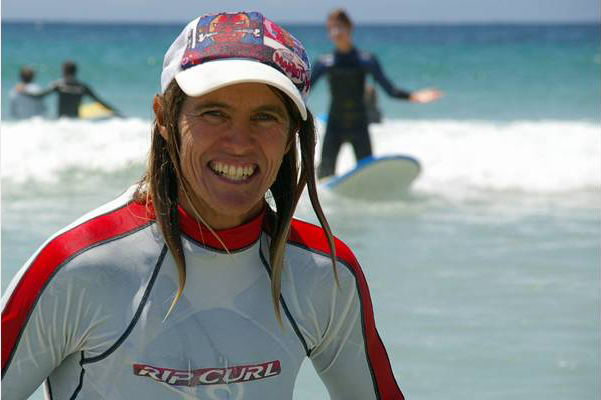
Pam Burridge encourages women to have a go at surfing.
Twice a week Pam Burridge and up to 10 women, all aged in their 40s or 50s, go in search of “that perfect wave” on the New South Wales South Coast.
Some are trying it for the first time, while others are going back to their teenage years – before careers and families consumed most of their lives.
“For most women, it’s definitely all about finding their own space,” Pam said. “When they’re in the surf, they forget about everything else that’s going on in their lives and just enjoy the moment – it’s a really cleansing feeling. Being in the ocean gives women a new sense of freedom and of being at one with nature.”
Women can take on the waves, at any age, Pam says, so long as they’re “relatively fit and strong”.
She said just walking to the beach and paddling out can be a workout, while catching a wave, then finally standing up was the ultimate reward. “It’s an all over body workout and the upper body gets a real flogging,” she laughed. “The core is strengthened and there’s a wide range of motion and movement involved. “Learning to surf can be really hard and frustrating but, when you catch your first wave, you get a feeling of absolute delight. “It’s a real rush,” Pam said. “I’ve been surfing since I was 10 and you never lose that feeling – it’s the biggest natural high. It’s definitely addictive.”
One of Pam’s students, Roz, took up surfing at the age of 41 and has hardly missed a session in the past five years. She said the death of her father inspired her “to get out there and live life”.
“I love it,” she said. “Surfing has become a part of my life and has made me fitter and healthier. “Now my daughter is learning as well, so we can go out together.”
Another student, Leanne, decided to “give it a go” while watching her son surf. “I got sick of sitting on the beach watching, so thought I’d try it,” she said.
Debbie, a single mother who spends most of her time in a medical lab, has gone back to her teenage “surfie chick” years and is loving every minute of it. “It’s a break away from being a mum and a doctor,” she said. “Surfing is something I’d encourage people to try.”
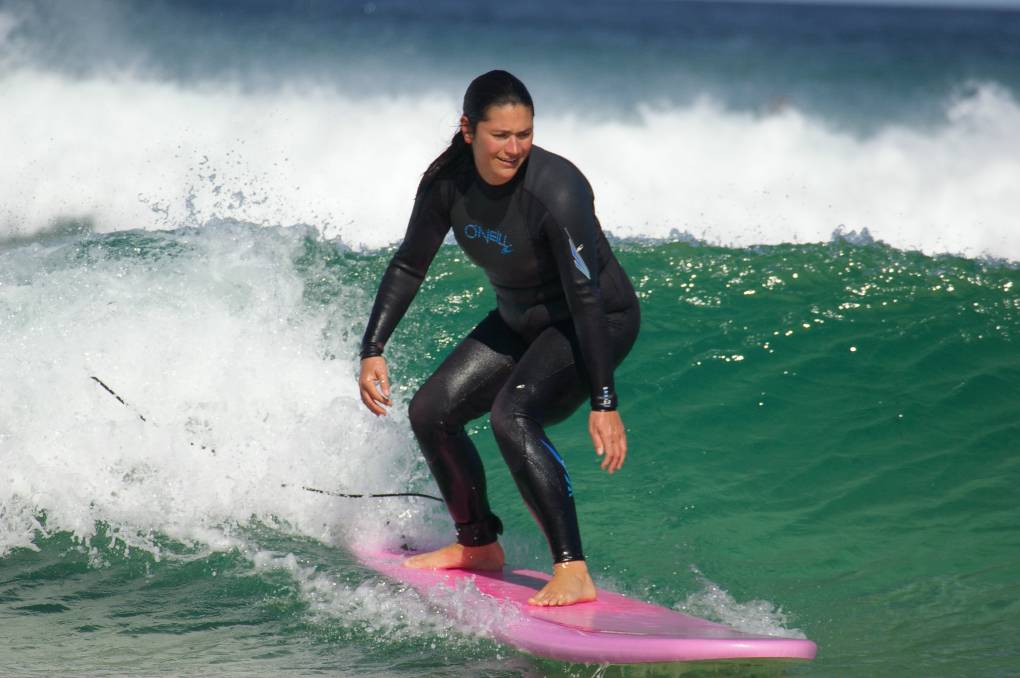
A nurse and mother of twin boys, Emma broke her back and was forced to give up boogie boarding in her 20s but, after regaining her strength, has returned to the waves on her pink surf board. “I just love getting out there when I can,” she said. “You feel so good afterwards.”
The woman agreed learning to surf with a former world champion was a real privilege and, aside from sharing the waves, the ladies often shared coffee or breakfast at a local cafe after their morning surf session.
Pam said some women were “a bit daunted” by her past when they first paddled out, but she quickly put them at ease. “They realise I’m down to earth and just a normal person,” she said. “It doesn’t take long and we’re all having a laugh.”
As well as making women feel more confident, Pam said surfing was a lifestyle choice.
“Surfers are generally fit and healthy,” she said. “They are usually less stressed and happier people – especially after a good wave.”
Pam said if women want to learn to surf they should seek out lessons or get a group of like-minded people together and give it a go in calm conditions.
GETTING REAL WITH PAM
For Pam Burridge, life is no longer about winning titles or travelling the world. It is about family, friends, her community and chasing the “perfect wave”.
After taking out the Women’s World Title in 1990, Pam was still competing when she moved from Sydney’s north shore to Bendalong with her partner Mark Rabbidge in 1995. She retired in 1998 before the birth of her first child, Isobel, in 1999 and Otis two years later.
In 2004 she launched Pam Burridge Surf Schools and now teaches women, school children and holiday makers to surf and stand up paddle board. She also runs women’s surf retreats on the clean, uncrowded beaches of the South Coast.
But surfing is not all business for Pam, it’s more about being part of a close-knit community and sharing her talents with people of all ages. She said she “feels privileged” to have performed so well in the surfing arena, but admitted moving away from the city, and the “surreal life” she was living, has made her a better person.
She is an avid supporter of the Cancer Council following the death of a friend’s son at the age of eight. Jeremiah del Tufo lost his battle with brain and spinal cord cancer three years ago and, as a close friend of the family, Pam has organised the annual “J Day’ fundraising event is his honour.
Jeremiah’s mother, Nicole Woodford, said Pam has helped raise almost $30,000 for brain cancer research. “As a friend she has supported myself and my family through the trauma of losing J with many wise words. “I will remember forever watching her ride her skateboard across the lobby of the children’s hospital at Westmead dragging an Esky on wheels behind her full of home-cooked Jeremiah favourites.”
Nicloe sums up Pam Burridge as “a humble, kind and generous woman who does so much for the community without expecting anything in return”.
To find out more about Pam’s surf lessons and retreats go to: www.pamburridge.com
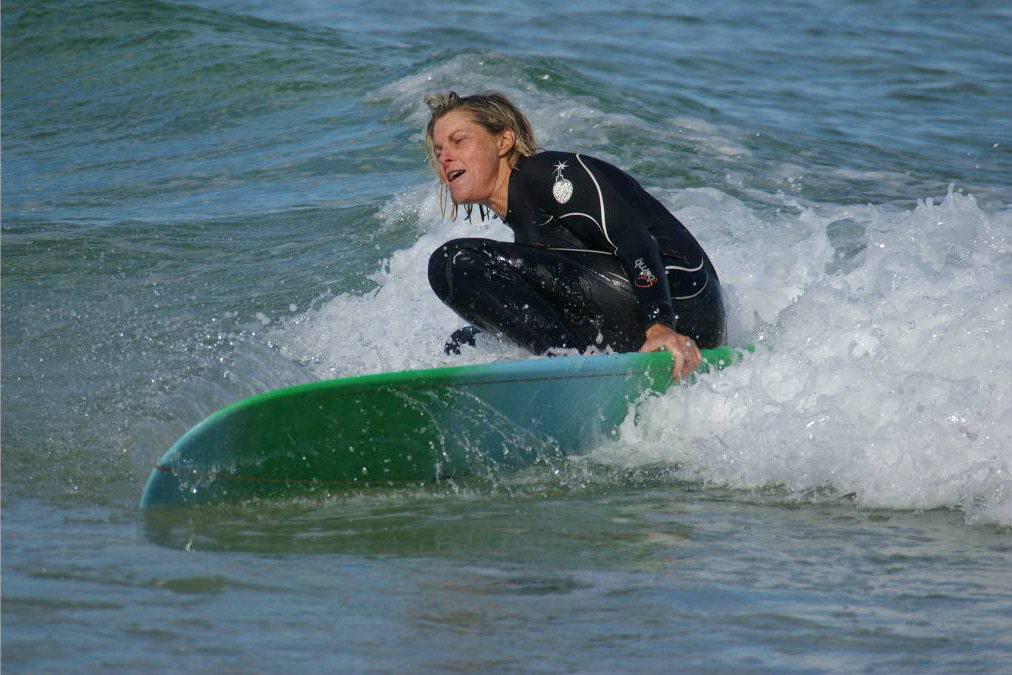
Emma and Roz hit the waves with Pam Burridge on the NSW South Coast.

 Katrina Condie Media & Marketing